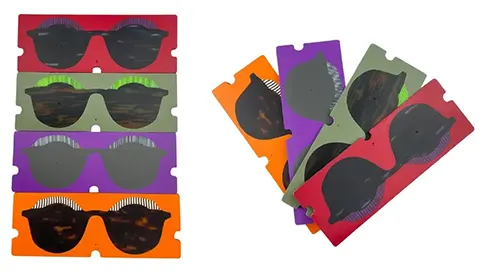
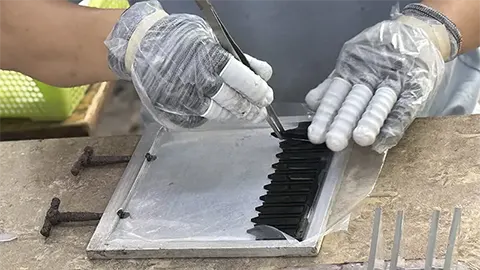
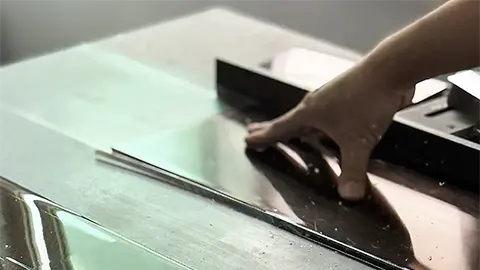
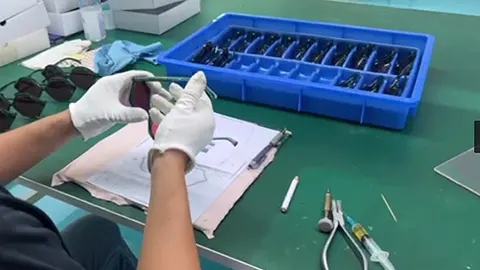
Patchwork acetate glasses are made by cutting different colored acetate sheets into matching pieces, bonding them with an acetate-based solvent, curing the block under controlled heat, then CNC-machining the bonded block into a frame. The whole process takes 2–3 weeks and passes through 6–8 hand stages. Here is how it actually runs on our factory floor in Shenzhen Longgang.
It starts with the sheets. A patchwork frame might use three, four, or five different acetate sheets — each with its own color, pattern, and hardness. The first job is picking sheets that will behave the same way under heat and pressure.
This is where a lot of factories get it wrong. Two sheets can look identical on the shelf but shrink at different rates once they are cut and bonded. We track acetate lots and test shrinkage behavior before the project starts. A sheet that looks right but moves differently is a sheet that will show a seam after polishing.
Once the sheets are chosen, we flatten each one and cut it into precision pieces. The pieces are not random — they are designed so the color zones match the final frame's shape. A geometric pattern needs geometric cuts; a wave pattern needs wave cuts.
Cutting is done on CNC equipment, not by hand. The pieces need to fit within ±0.1mm before bonding, or the seam will be visible after polishing. After cutting, each piece is checked for flatness. A piece that is 0.05mm off will throw the whole bond line out of alignment.
This is the step that separates a real splicing factory from one that just says it does splicing.
We do not use glue. We use a cellulose acetate solvent — the same base material as the sheet itself. The solvent softens the surface of each piece so that when two pieces are pressed together, the acetate dissolves into itself and re-forms as one block. Not two blocks joined. One block.
This matters for two reasons. First, there is no visible bond line — the material is literally continuous. Second, there is no color bleeding between layers, because the pieces are not glued on top of each other. They are fused.
The bonding stage takes place within a temperature-controlled environment, and each block is pressed under controlled pressure for a set time. Rushing this step is the fastest way to produce a frame that cracks six months later.
After bonding, the block rests for at least 5 hours for surface drying. Then it goes into a ~45°C oven for controlled curing.
For high-end frames — the ones where the brand will be selling at $150+ retail — we run a 7–10 day controlled shrinkage process in a temperature-stable oven. This is not standard practice. Most factories skip it because it costs floor time. But it is what keeps a patchwork frame flat and stable after it ships to a dry climate like Denver or a humid one like London.
When the block comes out of curing, it looks like a single sheet of acetate with the patchwork pattern already built in. The color boundaries are clean. There is no visible seam. At this stage, the block is still flat — it has not yet been shaped into a frame.
This is the step most people never see. The bonded block is the actual material outcome of the splicing process. Everything after this is standard eyewear manufacturing.
The bonded block is flattened one more time, then moved to a precision CNC machine with custom fixtures. This is not a general-purpose lathe. The fixtures are designed for each frame shape, and they hold the block at the exact angle needed for the pattern to align correctly across the front and temples.
Standard alignment tolerance is ±0.1mm. For frames with complex geometric patterns — where the pattern on the front has to match the pattern on the temple corner — we run a second high-speed CNC finishing pass on the full frame after shaping. That second pass is what makes the pattern look like it flows continuously around the frame.
After CNC, the frame exists in its final shape but not its final finish. The surface is still matte and slightly rough. Edges are not yet rounded. The bond line is visible under strong light but has no physical seam.
This is the stage where you can already see whether the patchwork pattern works. If the color zones are misaligned, it shows here — before 50 hours of polishing gets invested into a frame that will be rejected.
Polishing is where the frame earns its retail look. It runs in three stages: fine, medium, then fine again — inside a tumbler for a combined 50+ hours. The tumbling removes surface tool marks. It also softens any slight unevenness at the bond line.
But tumbling alone does not finish a patchwork frame. Different colored acetate sheets can vary slightly in hardness, and the harder sheet will polish slower than the softer one. If both are tumbled for the same time, one side ends up over-polished and the other under-polished.
That is why the final stage is hand polishing. A craftsman checks the bond line by feel — running a fingernail across the seam — and adjusts pressure accordingly. The goal is a surface that is perfectly flat across the color boundary with no ridge, no dip, and no visible line.
Every patchwork frame goes through a three-point check before assembly: seam alignment, color match, and hinge torque. The frame is inspected under both daylight and indoor lighting, because a color mismatch that is invisible under one will show under the other.
Lenses, hinges, nose pads, and temple tips are assembled after QC. Then the finished frame is packed with the brand's custom case, pouch, and cloth.
A patchwork acetate frame is not just a decorated single-color frame. It is a different manufacturing process with its own cost structure, timeline, and risks. Understanding the steps helps you ask the right questions during sampling and set realistic expectations on lead time.
Three frames in our current collection show how different patterns translate into finished product: XY-204 uses a bold block pattern across the front; XY-233 uses finer geometric zoning; and XY-206 combines transparent and opaque sheets in a layered effect.
If you are planning a patchwork collection, talk to our OEM/ODM team — we can review your color zones, confirm MOQ at 300 pairs, and give you a realistic timeline from sample to shipment. Or contact us directly to start the conversation.