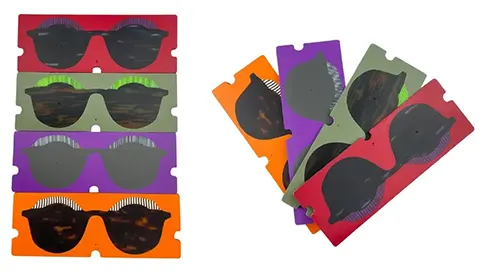
Spliced acetate is a type of acetate frame built from separate sheets of colored or patterned acetate, cut and bonded before the frame is shaped. The result looks like a single piece — no visible seams, no printed patterns, no painted color. The color runs through the material. For eyewear brands, splicing is one of the few remaining ways to make a frame that no other brand can copy exactly.
Standard acetate frames come from a single sheet. One color, one pattern. If you want a frame that looks different from everyone else's, your options are limited: change the shape, change the finish, or change the color. But even a new color gets copied within a season.
Splicing solves a different problem. It lets you build a frame from multiple acetate sheets — amber and navy, olive and cream, transparent and tortoiseshell — bonded into one front. The frame becomes a composition, not a single material choice.
This is why splicing has become a signature technique for brands that want recognition. A solid-color frame competes on shape and price. A spliced frame competes on identity.
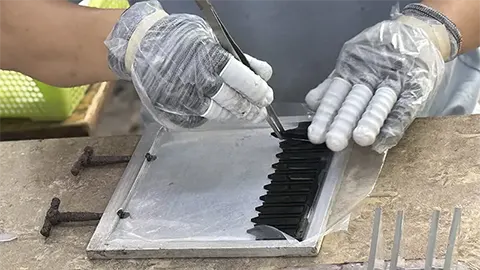
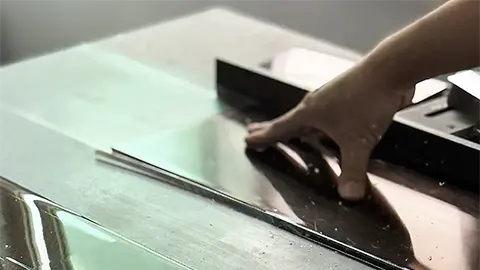
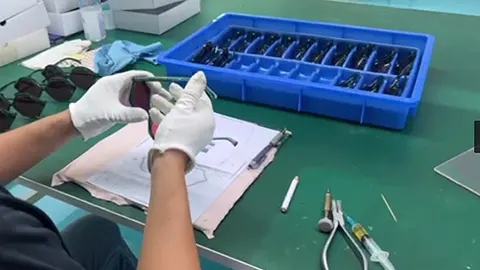
Splicing is not a color trick. It is a manufacturing discipline with its own hand stages. A spliced acetate frame typically goes through six to eight manual steps before final QC:
Sheet selection — choosing acetate sheets that match in thickness, hardness, and shrinkage behavior
Pre-drying — acetate holds moisture; without drying at around 60°C, sheets shrink unpredictably during processing
Cutting — each piece is cut to fit the design's color zones
Bonding — solvent-based adhesive softens the acetate surfaces so the pieces fuse at a molecular level
Curing — bonded blocks rest to stabilize before shaping
Shaping — the block is milled and formed into the front profile
Tumbling and polishing — multi-stage polishing removes the bond line
Final QC — seam alignment, color match, and hinge torque are checked on every frame
Most factories can do steps one through three. The hard part is steps four through seven. That is where splicing separates a specialized workshop from a general acetate factory.
Three problems show up again and again, and they are all visible only after polishing:
Color lot mismatch — two acetate sheets can look identical on the shelf, then shift color after bonding. Factories that do not track acetate lots end up with a visible color break in the finished frame.
Seam misalignment — a 0.2 mm offset is invisible on the rough blank. After polishing, it becomes the first thing a buyer sees.
Polish burn-through — too much heat at the bond line softens the joint. QC either rejects the frame or it fails in the field.
These are not theoretical risks. They are the reason most factories do not offer splicing as a standard option. It requires experienced hands, careful lot tracking, and a QC process built specifically around the bond line — not just a general frame inspection.
Compared to standard single-color acetate, spliced acetate goes through roughly twice as many production stages (six to eight versus three to four). The visual result is layered and immediately recognizable instead of clean and uniform. Brand recall goes up because the frame itself carries a signature. The QC focus shifts from surface finish and hinge function to seam alignment, color lot consistency, and bond line integrity.
The MOQ does not change. Both standard and spliced acetate frames can start at 300 pairs. What changes is the level of coordination required between your design brief and the factory's production planning — the color zones, sheet sourcing, and QC checkpoints all need to be agreed before production starts.
Standard acetate is still the right choice for core basics and high-volume repeats. Spliced acetate is the right choice for signature styles and launch collections.
Three practical advantages:
First, differentiation without a new mold. You can offer multiple color combinations of the same shape by changing the acetate sheets, not the tooling. That means more variety at 300 pairs, not just at 3,000.
Second, a story that customers can repeat. "The color is made into the material" is easier to explain than a technical coating or a laminated print. It holds up under close inspection, which matters for premium retail.
Third, protection from easy copying. A solid-color frame can be duplicated by any factory with the same sheet. A specific spliced combination, with its own color zones and seam placement, is harder to reproduce without the original production notes.
If you are sourcing a spliced acetate collection, ask these questions before you commit:
Can you show me a polished spliced sample, not just a rough one?
How do you track acetate lots between batches?
What is your pre-drying temperature and schedule?
How many hand stages does a spliced frame go through before QC?
What does your bond line inspection check for?
A factory that can answer these in specific terms is a factory that does splicing regularly. A factory that gives general answers is likely outsourcing the work or learning on your order.
We have been producing acetate eyewear in Shenzhen Longgang since 2010 — over 15 years, with splicing as a core capability rather than a sideline. Every spliced frame we ship goes through a three-point QC check: seam alignment, color match, and hinge torque. Approved samples stay on file, so if a brand reorders six months later, the color match holds.
If you are planning a color-differentiated collection, you can browse our custom spliced acetate sunglasses to see how the technique translates into production frames. For a project brief, talk to our OEM/ODM team — we can review your color zones, confirm MOQ at 300 pairs, and give you a straight answer on which combinations hold up after polishing and which ones do not. Or contact us directly to start the conversation.