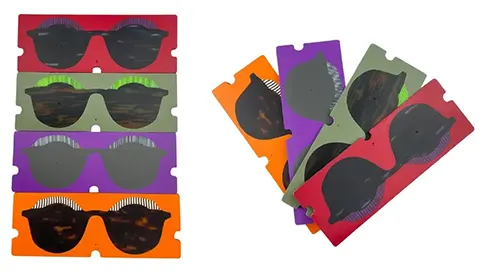
Starting an eyewear brand is less about a logo and more about one frame lane, one manufacturing partner, and one reason buyers should care. For most small brands, that means an OEM/ODM factory with a MOQ low enough to test the market—and a lead time that doesn't drag just because the order is small. A material story like spliced acetate helps you stand out.
The fastest way to waste money is to launch with five frame styles and no clear customer. Factories can make almost anything. That does not mean your first order should try everything.
Pick one lane: acetate sunglasses, titanium optical frames, or spliced acetate. If you are targeting fashion-forward buyers, custom spliced acetate sunglasses are often the strongest starting point because the frame itself becomes the marketing. If you are selling to optical practices, titanium or acetate-metal combinations may fit better.
Before you contact a factory, write down four decisions:
Frame category and target retail price
Two or three color directions, not twenty
Lens type, hinge type, and packaging level
Launch quantity: 300 pairs, 500 pairs, or a staged rollout
Would you rather sell a frame that looks like everyone else's, or one buyers ask about? That question should shape your first product lane. In our experience, brands that start with one strong style and 300 pairs learn faster than brands that spread 3,000 pairs across ten weak styles.
OEM and ODM are not the same business model, and mixing them up creates expensive delays. OEM means you bring the design. ODM means you adapt an existing factory design with your brand, colors, and packaging.
Here is the practical difference for a small brand:
OEM — you (or you with factory input) design the frame. Tooling is usually custom and can be exclusive. MOQ is 300 pairs for custom acetate styles. Lead time is 45–60 days after sample approval. Best for a brand with clear DNA.
ODM — the factory's existing mold and shape are the starting point. Molds are often shared unless you buy exclusivity. MOQ can be lower on stock molds, but 300 pairs is common. Lead time is 45–60 days for custom colors and branding. Best for a first capsule or market test.
A common mistake: a new brand asks for ODM pricing, then sends a fully custom sketch. That is OEM work. It will cost more and take longer. Another mistake is choosing OEM before understanding color and material limits. Acetate is not paint. You cannot match every Pantone color in every finish.
In our factory, a client once switched from ODM to OEM after seeing a spliced sample. It added about three weeks to the schedule, but the frame became exclusive. For a 300-pair launch, that trade-off can be worth it if the design is the brand. If you need help deciding, review our custom OEM/ODM eyewear services and ask for a straight answer on what is stock versus custom.
Splicing is not a color trick. It is a manufacturing discipline that few acetate factories handle well. A spliced acetate frame is built from separate acetate pieces, cut and bonded before shaping. The final frame looks like one piece. That is the hard part.
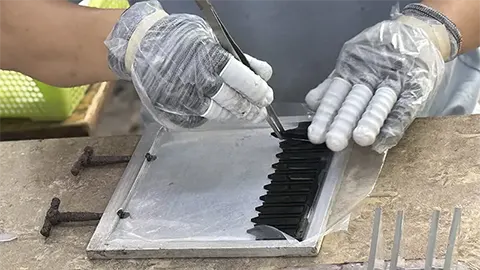
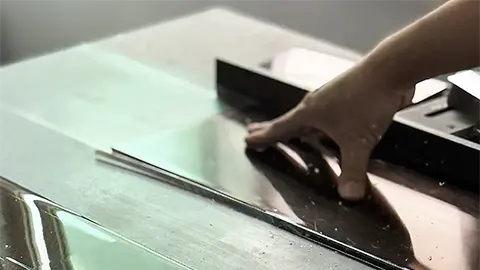
Why do so many acetate frames look the same? Because most factories default to single-color blocks. They are faster to source, easier to polish, and less risky. Splicing adds hand stages: sheet selection, cutting, bonding, curing, shaping, tumbling, and polishing. In our Longgang workshop, a spliced frame can pass through six to eight hand stages before it reaches final QC.
The technical risks are real:
Color lot matching — two acetate sheets can look identical until they are bonded
Seam alignment — a 0.2 mm shift is visible on a polished frame
Material shrinkage — different acetate lots can move at different rates during finishing
Polishing burn-through — too much heat can soften the bond line
That is why splicing is not a default option. It is a specialty. For a brand, the payoff is recognition. A single-color frame competes on shape and price. A spliced frame competes on identity. It also supports custom color stories without needing a full custom mold for every idea.
Compared to single-color acetate, spliced acetate gives a layered, distinctive visual result and stronger brand recall. It requires more handwork, but the MOQ stays at 300 pairs. The main risk shifts from color consistency to seam and color matching. Single-color is best for core basics; spliced acetate is best for signature styles.
If you want to see how this works on the factory floor, our factory in Shenzhen Longgang has been producing acetate eyewear since 2010. 15+ years teaches you which color combinations hold up after polishing and which ones fail after a few hundred pieces. That experience matters more than a fancy catalog.
300 pairs sounds small until you multiply it by tooling, lenses, packaging, freight, and your own marketing. The real question is not "Can I afford 300 pairs?" It is "Can I sell 300 pairs before I need the next order?"
Our standard MOQ is 300 pairs. Production lead time is 45–60 days after deposit and sample approval. That window does not include the 2–3 weeks you should reserve for sampling, color approval, and packaging sign-off. If you are launching for a spring season, start in the fall. Waiting until January is how brands end up paying for air freight.
A first-order budget should include:
300 pairs of frames
Lenses, even if they are simple demo lenses
Hinges, screws, and nose pads
Branded case, pouch, cloth, and box
Shipping, duties, and compliance testing
5–10% extra units for damage, samples, and influencers
The cash-flow mistake we see most often is ordering packaging separately and late. A custom box can have its own MOQ and 20–30 day timeline. If the frames arrive first, you are paying for storage and delaying sales. Plan the frame and packaging together.
Most first-order problems are not factory defects. They are approval problems. A brand approves a sample under office light, then rejects the bulk under daylight. Or they approve a frame but forget to sign off the hinge color.
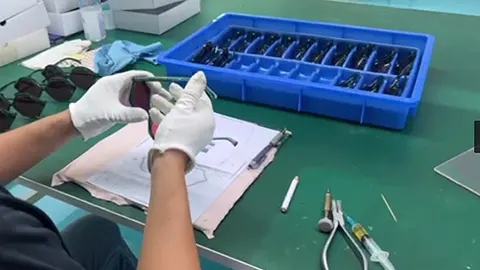
For spliced acetate, QC needs to focus on the bond line. We run a three-point check on every spliced frame: seam alignment, color match, and hinge torque. That catches the issues that matter most after polishing. For the full order, we inspect before packing and keep approved samples on file.
What should you do as the buyer?
Sign a physical sample, not just a photo.
Approve the acetate color under daylight and indoor light.
Confirm lens, hinge, and packaging specs in writing.
Ask for material certificates and lens test reports early.
Book a third-party inspection if your order is above 1,000 pairs.
Here's the thing: a good factory will tell you when a design is risky. A bad factory will say yes to everything and fix it later. For a first eyewear brand, the partner matters as much as the product. If you want to start with one spliced acetate frame instead of a 20-style catalog, contact our team. We can review your idea, confirm MOQ at 300 pairs, and map a 45–60 day production window.