Two Google searches bring people to this page: "acetate sunglasses repair" and "what does acetate mean". Both are consumer questions. And both are usually answered by retailers who sell frames and have never built one.
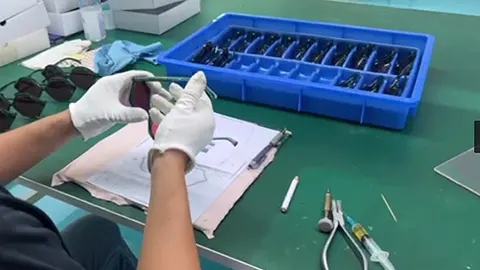
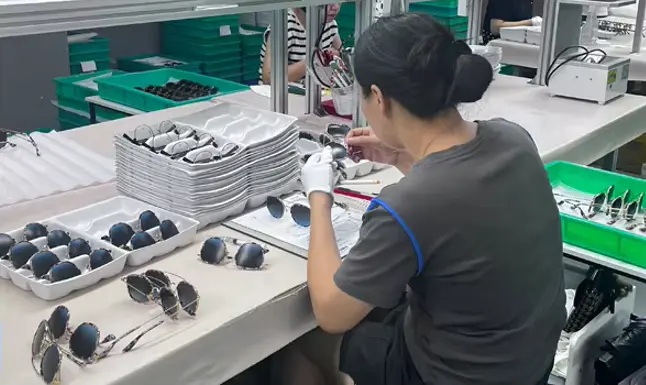
This is the view from a factory that has been producing spliced acetate frames in Longgang, Shenzhen since 2010.
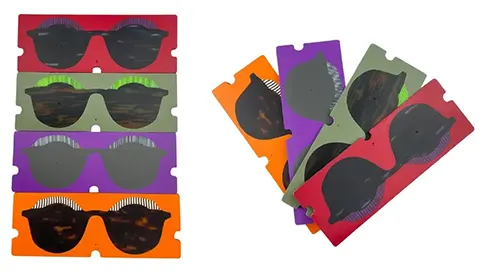
Cellulose acetate is a sheet plastic made from cotton pulp and acetic acid. It reaches our floor as slabs, in blocks of colour. We cut it, bond it, CNC it to register, tumble it, polish it.
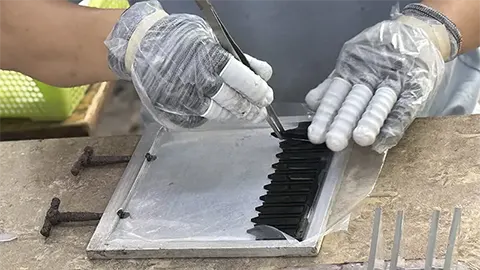
The tumbling is the part that matters. 50–70 hours, coarse to fine, in stages. No injection plastic takes that finish. And acetate can be re-polished, re-bent and re-bonded years later. TR90 cannot. Once a TR90 frame is molded, a scratched temple stays scratched.
That is why "acetate sunglasses repair" gets searched and "TR90 sunglasses repair" does not.
Most "broken sunglasses" are a loose screw or a stripped hinge plate. Tighten it. Do not crank it.
Acetate is soft around the screw boss. Two turns past snug and the hole opens for good — there is no material to put back. A repair shop will offer you a bigger screw. That is the beginning of the end for that temple.
This is where the internet says superglue. Don't. Cyanoacrylate leaves a white bloom along an acetate joint within weeks, and it cannot be polished out.
Acetate bonds by solvent. The same base material dissolves at the joint and re-forms as one piece — no glue line, no colour bleed. A real repair means: clean the break, apply solvent, clamp to ±0.1mm register, rest at least 5 hours, then re-tumble 50–70 hours to blend the finish back in.
Three days of shop time, on a frame we run at 300 pairs minimum. No repair shop does that at a price a consumer will pay. That is the honest reason most of them say "buy new".
Two constructions, two different fixes.
Molded acetate pads — the pad is part of the front, which is most sunglasses. It only moves by warming the frame. Keep it near 45°C, the temperature we cure at, and move it once. Overheat and the surface goes glossy, then crazes. A second adjustment on the same pad usually cracks it.
Metal-arm pads — most optical frames, such as XY-253 titanium-temple optical frames. Bend the arm, never the pad. Then replace the silicone pad itself. It is a consumable, and it costs less than the labour to clean it.
Alcohol. Acetone. Hand sanitiser. All three dissolve acetate. They craze the surface into micro cracks that read as fog.
Same chemistry that lets us fuse two colours, pointed the wrong way. Lukewarm water, mild soap, nothing else.
Acetate keeps shrinking for weeks after machining, and it holds a set. A frame left on a dashboard through July has taken one. Warm it, bend it back, and accept that the second correction will be brittle.
The factory fix happens before you ever see the frame: 7–10 days in a temperature-controlled oven. Cheap lines skip the oven because it ties up capacity. The frame fits in the shop and rocks on the temple by winter.
Repair claims are a warranty line, not a customer service annoyance. A 0.2mm register slip at the seam is invisible on the raw blank. It appears after polishing, on the customer's face, at month eight.
Three things prevent it. All three are inspectable before you place an order:
The spliced acetate process breaks down the 6–8 manual steps behind a two-colour frame, the craftsmanship page shows where each QC point sits on the line, and the final polishing video shows the last stage before packing. If you are replacing a cracked pair rather than repairing it, XY-204 is a spliced front built with a bridge seam you can spec in writing.
We run 300 pairs per design, 10–15 business days for the first sample, 45–60 days after approval. If you are sourcing a repair-prone frame — thin temples, a bond line across the bridge — send the tech pack to our contact page and ask for the seam spec in writing. The OEM and ODM overview covers what has to be in that pack before we quote.
No. Cyanoacrylate leaves a white bloom along an acetate joint within weeks, and it cannot be polished out. Acetate needs solvent bonding: the base material dissolves at the joint and re-forms as one piece, clamped to ±0.1mm, rested at least 5 hours, then tumbled 50–70 hours to blend the finish.
Molded pads are part of the front and only move by warming the frame to about 45°C, once. Metal-arm pads: bend the arm, then replace the silicone pad — it is a consumable.
Alcohol, acetone and hand sanitiser dissolve the acetate and craze the surface into micro cracks that read as fog. Use lukewarm water and mild soap only.
For a consumer: tighten the screw, try solvent on a clean break, and replace the frame when a seam has really failed — a full factory-grade repair costs more than most retail frames. For a brand: a returned frame is a warranty claim and a signal about the production line. If the same seam keeps failing across a run, the fix belongs upstream, in the seam spec and the QC point before polishing, not in the after-sales flow. Acetate and TR90 age differently, which is why acetate frames can be reworked at all and molded frames usually cannot.